Introduction & overview: Engineering automation refers to the targeted use of AI and automation to make development processes more efficient, consistent and data-driven. The focus is on close collaboration between developers and engineering copilots, AI agent systems and future-proof engineering IT.
In product development, companies benefit from the consistent use of all development data across system boundaries, the automated processing of technical information, and a direct connection between models, regardless of specific tools or providers.
On this page, you will learn:
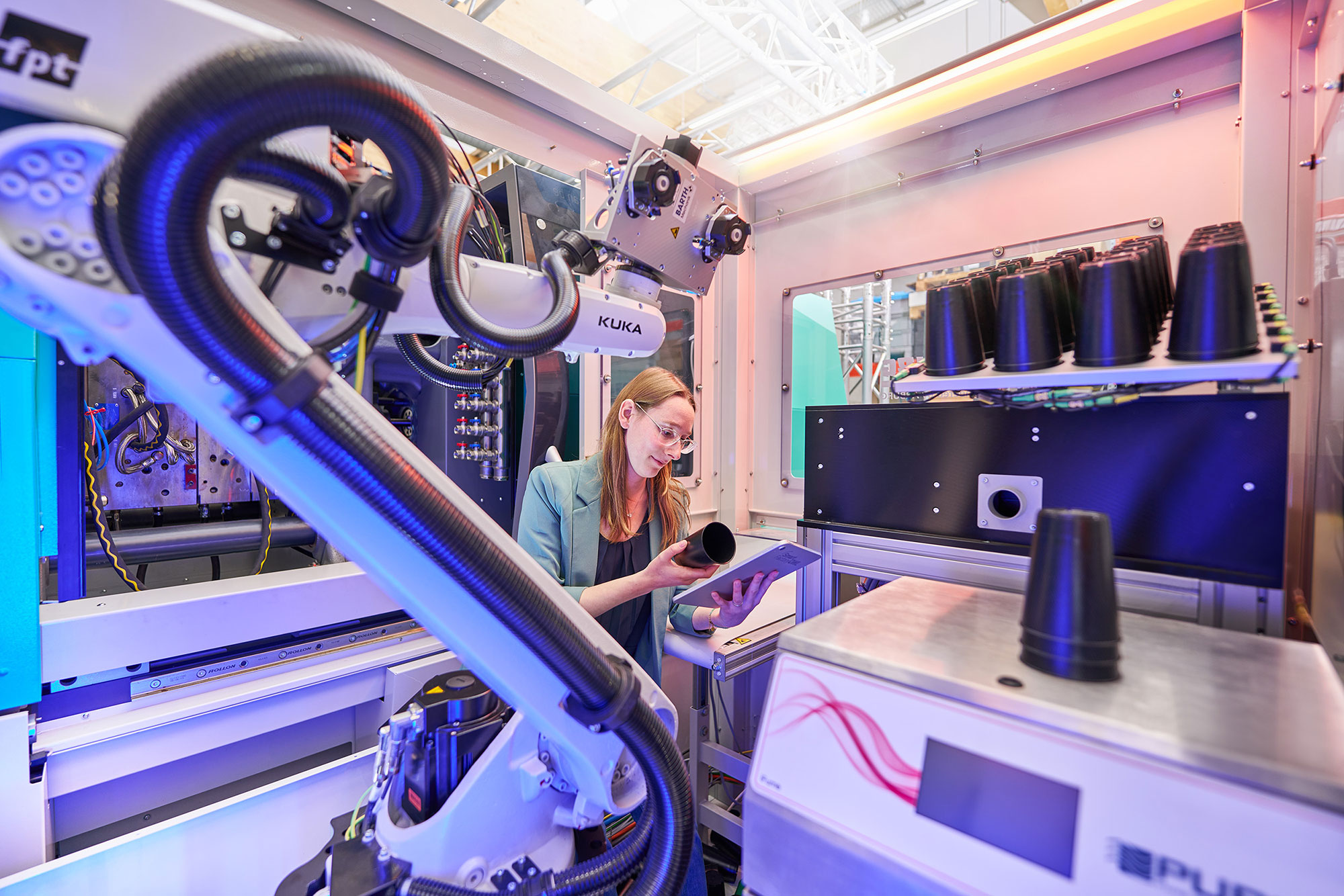
Engineering automation describes the targeted use of artificial intelligence and automation to make development processes more efficient, consistent and consistently data-driven: from the early idea phase to validation and optimisation based on field data. The core components are intelligent assistants such as engineering co-pilots or AI agents (multi-agent systems) that provide targeted support to developers.
Large language models (LLMs) form a central basis for this: they analyse requirements, optimise designs, generate code or support the generation of system architectures. The retrieval-augmented generation (RAG) principle enriches these models with domain-specific knowledge from engineering databases, PLM/ALM systems, etc. to deliver context-relevant, accurate results. This allows existing company knowledge from product development to be utilised.
In addition, fine-tuning is used to adapt AI models to industry-specific terminology, processes and standards. This increases their performance in an industrial context and provides companies with tailor-made AI solutions that can be reliably integrated into existing workflows.
AI agents (often implemented as multi-agent systems) take on defined tasks, exchange results with each other and integrate them into the development process. This creates seamless collaboration between human developers and AI applications. Tools and data sources are connected via standardised interfaces such as the Model Context Protocol (MCP) or APIs. This results in end-to-end consistency in the development process, robust traceability and reliable decision-making bases.
Engineering automation includes everything from the targeted automation of individual development steps to a vision of semi-autonomous systems and engineering IT that seamlessly integrates AI solutions. The goal is a natural collaboration between developers and AI throughout the entire development process – from the initial concept to market readiness. For you as a company, this means: copilots and tool add-ons that take the pressure off today, intelligent multi-agent systems in the medium term, and highly integrated, AI-supported engineering IT as the backbone of product development in the long term.
This allows recurring, time-consuming and error-prone work steps to be automated. For your company, this means less searching and coordination, faster iteration cycles, intelligent real-time support, targeted access to knowledge and sound decision support. At the same time, creative development processes are specifically promoted. The result: more capacity for what really matters – the development of innovative solutions.
Current
Engineering co-pilots and tool add-ons
Support for specific engineering tasks such as simulations or designs
Identification and implementation of dedicated co-pilots for full stack engineering
Medium term
Challenges such as traceability, consistency and transparency can be mastered
Merging engineering technologies with AI solutions
Long-term vision
AI systems as a central operating layer for data and workflows
Transformation towards sustainable engineering IT
Current
AI-based assistance systems (known as copilots) support engineers with specific tasks in the development process, for example by selectively automating individual engineering tasks. Various solutions are already available and are usually integrated into existing engineering tools as plug-ins. The key is to identify and implement copilots that are tailored to the specific requirements and processes of the respective company.
Solutions that can be implemented in the short term increase productivity and creativity in everyday development work without the need for costly restructuring of existing processes.
Medium term
The next area of development aims to achieve integrated, networked engineering with the help of AI-supported solutions. Multi-agent systems link development artefacts and enable continuously up-to-date, data-consistent development. For example, test specifications can be automatically derived from requirements. Dependencies are not only checked once, but are continuously reviewed and updated with every change or decision in the development process. This brings the vision of a holistic, consistent system model within reach.
Medium-term breakthrough toward (partially) automated development processes in which traceability and consistency are ensured and engineering technologies merge with AI solutions.
Long-term vision
Long-term development of engineering and enterprise IT with autonomous, AI-based systems. Medium-term breakthrough towards (partially) automated development processes in which traceability and consistency are ensured and engineering technologies merge with AI solutions.
AI has long been a reality in engineering and is already being used successfully in product development by numerous companies. Whether for the automated recording of requirements, the generation of consistent system architectures, intelligent data migration, automated code creation for robot systems or the use of AI in validation: AI-supported engineering processes are fundamentally changing product development.
On this page, we show you where AI can be used specifically in the engineering process – from idea generation to system design to validation – and which use cases are already delivering added value for companies today. The red areas mark cross-sectional areas, the blue phases the actual development process.
Engineering Management
Steering development, promoting innovation
Digital backbone
Integrate data, connect processes
System insurance
Testing systems, strengthening reliability
Understand needs, determine direction
Designing systems, modelling solutions
Implement solutions, prepare production
Support usage, secure operation
Utilize insights, develop systems further
This field of activity combines the management of technical projects and products: from requirements and innovation management to risk assessment and operational project management. It forms the structural basis for targeted development. Automated workflows, tool-supported templates and integrated reporting processes enable efficient project execution. AI-supported solutions, such as copilots for analyzing project and market data, provide well-founded decision-making aids, e.g. for prioritization, release planning or dynamic resource planning.
Engineering Management
Specific use cases
Data silos, media breaks and a lack of traceability slow down today's development processes. A continuous, version-secure data flow via consistent models and interoperable tool chains is the basis for scalable automation. Engineering automation supports this through semantic interoperability and automated synchronization. Development artefacts are linked consistently across systems. Enterprise IT architectures, AI graphs, digital twins and data spaces form the infrastructure for adaptive system landscapes, prospectively controlled by autonomous software agents.
Digital backbone
Specific use cases
This field of activity focuses on ensuring the safety, functionality and quality of technical systems throughout their entire life cycle. Safety and security by design, model-based validation, simulation-based approaches such as XiL, and well-thought-out test strategies form the methodological foundation. Engineering automation supports the automated identification of hazards and threats, the generation of test cases, the model-based feedback of test results, the data-based definition of intelligent test corridors, and AI-supported code analyses for the early detection and classification of safety-critical vulnerabilities.
System insurance
Specific use cases
In this early phase, technological trends, user requirements and system limitations are systematically analyzed and evaluated. The aim is to create a common understanding of the problem and the system context – as a sound basis for targeted development. Engineering automation supports this step with data-driven methods and AI-based tools, for example for the structured recording of user needs or the automated evaluation of unstructured text data. Early economic feasibility assessments and AI-supported idea generation promote strategic decision-making and accelerate innovation.
Explore & Plan
Specific use cases
In system design, technical systems are designed in a structured manner and mapped based on models. Logical and functional architecture as well as modularization strategies create a robust, adaptable system concept and enable the targeted control of variant diversity or reusability. Engineering automation supports this with data-driven and generative approaches, such as automated requirements capture or semi-automated architecture generation based on model-based libraries.
Define & Architect
Specific use cases
Concepts are transformed into functional hardware, software and production systems. The focus is on domain-specific development and seamless integration. AI solutions, such as intelligent co-pilots, support model-based approaches, automate processes and promote the reuse of standardized artefacts from libraries. Examples include the creation of PLC program modules, the derivation of design variants from parametric models, the optimization of system parameters for a coordinated overall system, and the layout planning of production systems.
Implement & Produce
Specific use cases
Deploy & Run
Deployment marks the start of the operational lifecycle of technical systems, with commissioning, monitoring, maintenance and (OTA) updates. Open microservice architectures enable scalable provisioning. Linking operational data and development models creates transparency about system statuses, error causes and maintenance requirements. AI-supported predictions enable early intervention, accelerate complaint processes and support the automation of service tasks, for example through voice assistants. The goal is stable, user-centered operation.
Deploy & Run
Specific use cases
Data and operational experience flow directly into further development – closed-loop engineering becomes reality. Systems become adaptive and capable of learning: functions can be specifically adapted and continuously improved based on data-driven analyses. This creates the basis for circular design: systems are further developed instead of replaced, and components are reused in a targeted manner. Furthermore, the systematic feedback of insights is supported, for example to optimize existing designs or to further develop model libraries.
Evolve & Reuse
Specific use cases
Would you like to implement specific AI solutions in engineering and are looking for a partner with in-depth AI expertise and many years of engineering experience? Together, we develop tailor-made solutions that integrate seamlessly into your processes and create real added value – from the first use case to productive deployment – use AI in product development. Would you like to learn more about our background, our team and our motivation? Take a look at our ’About us’ page.